The MONEY PLAY is HERE - Money done for you.
Become an O8 Affiliate – Earn 20% commission on all sales.

Business Owner Burnout: Why You're Working 60+ Hours and How to Actually Stop
You're not weak. You're trapped in a badly designed business. Different problem.
You wake up at 5 AM checking email. Work through lunch. Miss dinner with your family. Fall asleep thinking about tomorrow's problems.
You tell yourself it's temporary. "Once we get through this quarter." "Once I hire the right person." "Once we hit [revenue target]."
It's not temporary. It's design failure.
Business owner burnout isn't about working too hard. It's about working in a system that requires you for everything. You're not the weak link. You're the only link. And until you redesign the constraint that makes you indispensable, the hours don't decrease. They compound.
This is burnout through The O8 framework. You can fix your business operations all day. If you don't address how you're wired to run things, you'll rebuild the same trap.
Fix both or fix neither.
Why Business Owner Burnout Is Different (And Why Standard Advice Doesn't Work)

Employee burnout and owner burnout aren't the same problem.
Employee burnout:
Too much work, not enough control
Solution: Boundaries, time off, delegation to others
If it doesn't improve, they quit
Owner burnout:
Too much work, too much responsibility, no escape route
Can't set boundaries when the business depends on you
Can't quit without losing everything you built
Time off = coming back to a crisis
Standard burnout advice tells you to:
Practice self-care
Set better boundaries
Take more breaks
Delegate more
That advice assumes your business can function without you. Most can't.
The operational dependence trap:
You built a business that funnels every decision through you. Your team can't make calls. Your systems don't handle exceptions. Your customers expect you.
The burnout isn't from working too much. It's from being the single point of failure in a badly designed system.
Self-care doesn't fix systemic problems.
You can meditate, exercise, and take weekends off. If Monday morning brings you back to a business that needs you for everything, you're not recovering. You're delaying collapse.
The Real Causes of Business Owner Burnout

Burnout follows patterns. Here are the five constraints that trap you in 60+ hour weeks:
1. You're the Bottleneck in Every Critical Decision
Your team can execute. They can't decide.
What this looks like:
"I need your approval before I can proceed"
"What should I do about [routine situation]?"
"I didn't want to move forward without checking with you first"
Dozens of daily decisions that shouldn't require you but do
The constraint: Decision rights aren't delegated. Tasks are delegated, authority isn't.
Why it burns you out: Every decision interrupts your focus. Every interruption multiplies. You're not working on your business. You're being interrupted to death by it.
2. No Systems = Everything Requires You
You have processes. You don't have systems.
The difference:
A process is "here's how we do this task"
A system is "here's how we handle this task, these exceptions, these edge cases, and who decides what when"
What this looks like:
Documented procedures that only work in ideal conditions
The phrase "just this once" happens daily
Every exception gets escalated to you
Your team can follow the script but not handle reality
The constraint: Processes don't account for the real world. Systems do.
Why it burns you out: You're playing whack-a-mole with exceptions. Nothing runs without you because nothing is designed to run without you.
3. Growth Without Operational Scaling
Revenue grows. Your systems don't.
The pattern:
$200K/year: You can keep it all in your head
$500K/year: You're starting to struggle
$800K/year: You're drowning
$1M+: You're the constraint preventing further growth
What this looks like:
More customers, same chaos
More revenue, more problems
More team members, more coordination required
Hiring doesn't reduce your hours, it increases them
The constraint: You scaled revenue before scaling operations.
Why it burns you out: Every dollar of growth adds to your burden instead of relieving it. Success is making things worse, not better.
4. The "Only I Can Do It Right" Trap
You've tried delegating. It didn't work. So you keep doing it yourself.
What actually happened:
You delegated a task without the decision framework
You didn't document the edge cases
You micromanaged because the system wasn't trustworthy
They did it differently than you would (not wrong, just different)
You took it back
The constraint: You're comparing their execution to your intuition. Your intuition is the result of 10,000 reps. They have 5.
Why it burns you out: Everything important stays with you. Your team does the easy stuff. You do everything that matters. Your hours never decrease.
5. Financial Pressure from Poor Cash Flow Visibility
You don't know if you can actually afford to step back.
What this looks like:
Checking your bank balance constantly
Making decisions based on current cash, not forecasted availability
"We can't afford another person" (but maybe you could if you had visibility)
Financial stress that makes it impossible to think strategically
The constraint: No cash flow forecast means no confidence in your decisions.
Why it burns you out: Financial anxiety is constant. You can't plan. You can't invest in help. You can't take time off because you don't know if the money will be there when you get back.
The Burnout Test: Are You Running a Business or Being Run By One?
Here's the diagnostic. Answer honestly.

Can you take a week off without checking in?
No = You're the operational constraint
"I could, but things would pile up" = Same answer, different excuse
Do you have recurring nightmares about your business?
Yes = Your nervous system knows something your conscious mind is denying
Are you making decisions from exhaustion?
If you're deciding anything important after 7 PM, the answer is yes
Can you delegate a meaningful task and trust it will be done right?
No = Your systems aren't delegatable
"It's faster if I just do it myself" = You're the bottleneck
Has anyone you care about told you they're worried about you?
Yes = You're further gone than you think
When was the last time you felt genuinely rested?
Can't remember = You're not recovering, you're collapsing in slow motion
Do you feel guilty when you're not working?
Yes = You've tied your identity to being indispensable (dangerous territory)
Are you working more hours now than you were a year ago despite revenue growth?
Yes = You scaled the wrong thing
If you score 4+ yes answers: You're not managing burnout. You're in it.
And the solution isn't a vacation. It's redesigning the business that's burning you out.
How to Actually Reduce Business Owner Working Hours
Not time management. System design.
You can optimize your calendar, batch your tasks, and block your time. If your business is designed to need you for everything, you're still working 60 hours. You're just doing it more efficiently.
The O8 constraint approach: Find the bottleneck that creates the most hours. Fix it.
Step 1: Identify Your Time Constraint
Track your time for one week. Not what you think you're doing. What you're actually doing.
Categories:
Strategic work (deciding direction, planning, big decisions)
Operational execution (doing the work)
TDecision-making for others (approvals, exceptions, "what should I do?")
Crisis management (things that broke)
Administrative work (emails, scheduling, coordination)
The diagnostic question: Which category consumed the most hours?
That's your constraint.
Step 2: Trace the Constraint to Its Root
Most business owners blame the wrong thing.
What you think: "I'm spending too much time in email."
↣ What's actually happening: Your team doesn't have decision rights, so they're emailing you for approvals.
What you think: "I'm spending too much time managing my team."
↣ What's actually happening: You don't have systems, so you're managing every individual task instead of managing systems.
What you think: "I'm spending too much time on customer issues."
↣ What's actually happening: Your service delivery has no exception-handling protocols.
Don't fix the symptom. Fix the root.
Step 3: Apply the Constraint Method
Identify: You spend 20 hours/week answering "what should I do?" questions from your team.
Exploit: (Maximize current capacity before fixing it)
Batch all decision requests to one time per day (10 AM and 3 PM)
Create a "don't interrupt unless" criteria list
Document decisions as you make them for pattern recognition
This buys you focused time and reduces interruptions from 40/week to 10/week.
Subordinate: Everything else supports fixing the decision-making bottleneck.
Don't launch new projects while you're fixing this
Don't optimize other areas yet
All energy goes to making decisions delegatable
Elevate: (Fix it permanently)
Create decision matrices (who can decide what based on clear criteria)
Document edge case protocols (what to do when the standard doesn't apply)
Assign decision rights by role and threshold
Train team on decision framework, not just tasks
You've now elevated the constraint. Those 20 hours are back.
Step 4: Find the Next Constraint
Once you fix one time constraint, another appears.
The typical hierarchy:
Decision-making bottleneck (most common first constraint)
Crisis management/firefighting
Operational execution you haven't delegated
Administrative coordination
Strategic planning you keep delaying
Fix them in order. Don't skip levels.
Theory of Constraints Applied to Your Time

Theory of Constraints says: Every system has one constraint that limits throughput. Fix that constraint, and the next one becomes visible.
Your time works the same way.
You have 60-70 working hours per week. That's your capacity. Where are those hours going?
The constraint is whatever's consuming the most hours that shouldn't be.
Not "what takes time" but "what takes time and shouldn't require you."
Example hierarchy:
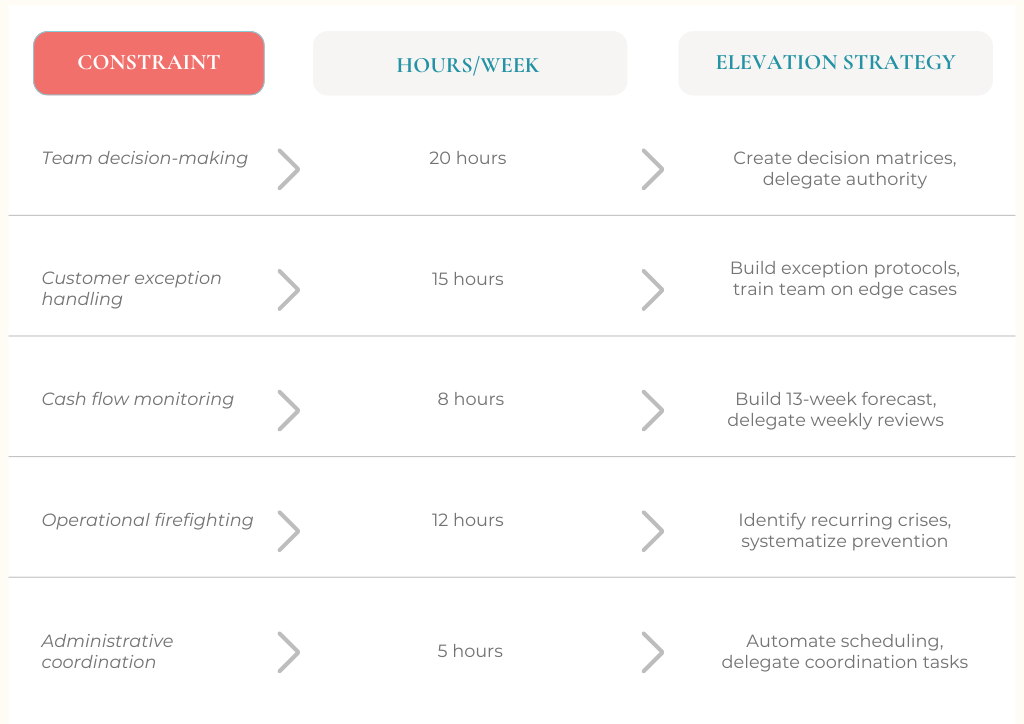
If you fix decision-making, you get 20 hours back. That's now capacity for strategic work or—radical idea—rest.
But here's the trap: Most owners take those 20 hours and fill them with more work.
Don't do that.
When you get hours back, protect them. Use them for strategic thinking. Use them for recovery. Use them to fix the next constraint.
Don't use them to become a more efficient bottleneck.
The Operating System Component: Why Some Owners Can't Stop

Here's what most burnout advice misses: Some owners can't stop even when systems are in place.
Not because they're workaholics. Because their operating system won't let them.
Your operating system includes:
How you derive self-worth (from being needed vs. from results)
How you handle ambiguity (need control vs. comfortable with uncertainty)
How you process rest (guilty vs. restorative)
How you relate to your business (identity vs. asset)
Operating system conflicts that prevent recovery:
Conflict 1: Self-Worth Tied to Being Indispensable
The pattern: If you're not needed, you're not valuable.
What this looks like:
You feel guilty when things run without you
You manufacture problems to solve so you stay relevant
You resist systematizing because it makes you replaceable
Your identity is wrapped up in being the hero
The constraint: Your operating system requires you to be the bottleneck.
The O8 fix: Shift self-worth from being needed to building something that doesn't need you. That's harder. That's more impressive. That's actual ownership.
Conflict 2: Inability to Trust Systems Over Intuition
The pattern: You trust your gut more than documented processes.
What this looks like:
You build systems but override them constantly
"I know the rule says X, but in this case..."
You can't let the system fail even when that's how it learns
Your intuition is your operating system, and you can't delegate intuition
The constraint: You've built expertise through 10,000 reps. Systems require time to build that same reliability.
The O8 fix: Give systems permission to fail small so you can trust them with big. Start with low-stakes decisions. Build evidence that the system works.
Conflict 3: Rest Feels Like Failure
The pattern: Productivity is virtue. Rest is weakness.
What this looks like:
You can't enjoy time off because you're thinking about work
Weekends feel like wasted time
You take your laptop on vacation "just in case"
You equate rest with laziness
The constraint: Your operating system punishes recovery.
The O8 fix: Reframe rest as strategic investment. You don't get better answers working 70 hours. You get worse ones. Rest isn't a reward for working hard. It's a requirement for working smart.
Conflict 4: Business as Identity vs. Business as Asset
The pattern: You are your business. It's not what you do, it's who you are.
What this looks like:
"I'm a [business owner]" is your primary identity
Threats to the business feel like threats to you
You can't imagine life without the business
Stepping back feels like losing yourself
The constraint: If you are your business, you can never leave it.
The O8 fix: Separate identity from execution. You're the owner. Not the operator. Build something that reflects your values but doesn't require your presence.
This is the operating system work. And it's harder than fixing operations.
You can build perfect systems. If your operating system sabotages them, they won't work.
Fix both or fix neither.
What Recovery Actually Looks Like (And What It Doesn't)

Recovery is not:
A vacation where you check email
"Taking Fridays off" but working 12-hour days Monday-Thursday
Delegating tasks but keeping all decision authority
Telling yourself you'll rest after [milestone]
Recovery is:
Building a business that runs without you for 30 days
Having capacity for strategic thinking instead of constant execution
Feeling genuinely rested, not just less exhausted
Making decisions from clarity, not desperation
The timeline:
Month 1-2: Acknowledge the Constraint
You're burned out. Not because you're weak. Because your business is badly designed.
Track your time for one week (what's actually consuming hours?)
Identify your primary time constraint
Start exploiting it (batch, defer, delegate what you can right now)
You're still working the same hours. But you're buying time to fix it.
Month 3-4: Elevate the First Constraint
Build the system that eliminates your biggest time drain.
Create decision matrices
Build exception protocols
Document edge cases
Delegate with authority, not just tasks
You're starting to see hours come back. Protect them.
Month 5-6: Address Your Operating System
Notice what you do with the hours you got back.
Did you fill them with more work? (Operating system conflict detected)
Did you use them strategically? (You're learning)
Did you rest? (Rare. Good for you.)
This is where the operating system work happens. Why can't you stop? What's driving the pattern?
Month 7-9: Elevate the Next Constraint
The business is more stable. You have capacity. Fix the next bottleneck.
Second biggest time drain
Same process: identify, exploit, subordinate, elevate
You're building a pattern of constraint elimination
Month 10-12: Test Extraction
Take 2-4 weeks fully off.
No laptop
No check-ins
No "just this once"
If the business runs, you've achieved extraction. If it breaks, you know what still needs fixing.
This is not fast. This is not magic. This is methodical.
Common Burnout Recovery Mistakes (And How to Avoid Them)
Mistake 1: Confusing relief with recovery
You take a week off. You feel better. You come back to the same system. Burnout returns in three weeks.
Fix: Don't just rest. Redesign the system that burned you out.
Mistake 2: Trying to fix everything at once
You're burned out, overwhelmed, and trying to overhaul your entire business simultaneously. This creates more stress.
Fix: One constraint at a time. Find the biggest time drain. Fix it. Move to the next.
Mistake 3: Delegating tasks without authority
You give your team work. You keep all decisions. They can't move without you. Your hours don't decrease.
Fix: Delegate decision rights, not just tasks.
Mistake 4: Ignoring your operating system
You fix operations. You rebuild the same patterns. Your operating system sabotages every system you create.
Fix: Address why you can't stop. Self-worth? Control? Identity? Fix both or fix neither.
Mistake 5: Waiting until you hit crisis
"I'll fix this after we get through [busy season]." You won't. Busy season never ends when you're the bottleneck.
Fix: Fix it now. The business will survive operating at 80% capacity for a few weeks while you build systems. It won't survive you collapsing.
The Hard Truth About Business Owner Burnout
Burnout isn't about working too hard. It's about working in a system that requires you for everything.
You can't fix it with self-care. You can't fix it with time management. You can't fix it by working smarter.
You fix it by redesigning the constraint that makes you indispensable.
Operations: Build systems that don't need you.
Operating System: Address why you can't let them.
That's The O8 framework. Fix both or fix neither.
You built a business that needs you for everything. That's not strength. That's bad design.
You're not weak for being burned out. You're exhausted from being the only link in a system designed to fail without you.
Fix the design. Fix the constraint. Fix your operating system.
Or stay burned out. That's a choice too.
Related Reading:
How to remove yourself from daily business operations (extraction framework)
How to delegate as a business owner (decision rights vs. tasks)
The 6 bottlenecks every business hits (constraint hierarchy)
THE GETAWAY
Your final destination for ditching the overwhelm and stress of running a business.
Get The BRIEF
Smart plays - straight to your Inbox!
Stay Connected
Hey there, let's hang out!