The MONEY PLAY is HERE - Money done for you.
Become an O8 Affiliate – Earn 20% commission on all sales.

Small Business Cash Flow Problems: Why Profitable Businesses Go Broke
Profit on paper. Broke in reality. That's a timing problem, not a mystery.
You made $80,000 last month. Your P&L says you're profitable. Your accountant isn't worried.
But you can't make payroll.
Your bank account says $3,200. Rent is due. Vendor invoices are stacking up. And you're wondering how a profitable business can be this broke.
Welcome to the cash flow gap. The constraint that kills more small businesses than bad products, bad marketing, or bad luck combined.
Here's what's actually happening: Money is coming in slower than it's going out. That's it. Not complicated. Not a mystery. A timing problem.
And like all constraints, you can't fix it by working harder or hoping it resolves itself. You fix it by identifying where the timing breaks, exploiting what capacity you have, and elevating the constraint permanently.
This is cash flow through The O8 framework. Operations + Operating System. Fix both or fix neither.
The Profit vs. Cash Flow Gap (And Why Your Accountant Isn't Warning You)

Your P&L and your bank account are telling two different stories. Both are true.
Your P&L says: You invoiced $80,000 last month. Expenses were $55,000. You made $25,000 profit.
Your bank account says: You collected $42,000. You spent $61,000. You're down $19,000.
The gap? Timing.
Your P&L uses accrual accounting. It counts money when you invoice it, not when you collect it. It counts expenses when you incur them, not when you pay them.
Accrual accounting is great for taxes. It's terrible for operations.
Here's what your P&L won't tell you:
That $80,000 invoice? Client has net-60 terms. You won't see it for two months.
That $15,000 in expenses? You pre-paid for inventory that won't sell for three weeks.
That profitable month? It drained your bank account by $19,000.
This is how profitable businesses go broke. They're managing to the wrong scoreboard.
The math:
82% of small business failures cite cash flow problems as a contributing factor
60% of small business owners don't feel confident managing their cash flow
The average small business has 27 days of cash runway
You're not failing. You're flying blind.
The 5 Cash Flow Killers in Small Business

Cash flow problems aren't random. They follow patterns. Here are the five constraints that create the timing gap:
1. Customer Payment Terms (The Receivables Constraint)
You invoice on delivery. Client pays in 45 days. You have expenses now.
The math:
$100,000 in monthly revenue
45-day average collection period
You're carrying $150,000 in receivables at any given time
That's $150,000 that should be in your bank account but isn't
The constraint: The time between when you deliver value and when you collect payment.
Common triggers:
Net-30, net-60, net-90 payment terms
Clients who pay "whenever" and you don't chase
Payment terms you agreed to without modeling the impact
Large projects with milestone payments (you're fronting costs for months)
2. Inventory Timing Mismatches (The Capital Lock-Up Constraint)
You buy inventory before you sell it. You pay suppliers before customers pay you.
The math:
You purchase $30,000 in inventory
Average time to sale: 45 days
You've locked up $30,000 in cash for 6 weeks
If supplier terms are net-15 and customer terms are net-30, you're paying out 15 days before you collect
The constraint: The gap between when you pay for goods and when you convert them to cash.
Common triggers:
Buying inventory in bulk to get discounts (saving 10%, losing liquidity)
Seasonal businesses that stock up months ahead
Custom orders where you purchase materials before client payment
"Just in case" inventory that sits
3. Overhead Creep During Growth (The Fixed Cost Constraint)
Revenue grows. You hire more people, lease more space, add more tools. Fixed costs jump before variable revenue stabilizes.
The math:
You add $8,000/month in payroll to handle growth
New revenue takes 60 days to stabilize
You've just increased monthly burn by $8,000 with no immediate offset
If you miscalculated demand, you're bleeding $8,000/month until you adjust
The constraint: Fixed costs are immediate. Revenue growth is delayed.
Common triggers:
Hiring ahead of revenue (betting on growth that's slower than expected)
Upgrading office space "because we need room to grow"
Adding software subscriptions "to scale operations"
Creating roles before confirming demand for them
4. Tax Timing Surprises (The Deferred Liability Constraint)
You made profit in Q1. You spent it in Q2. Tax bill hits in Q3. You don't have it.
The math:
Q1 profit: $60,000
Tax liability (assuming 30%): $18,000
You didn't set it aside
June comes. You owe $18,000. You have $4,000.
The constraint: Profit creates a future liability you forgot to account for.
Common triggers:
Quarterly estimated taxes for profitable periods
End-of-year tax bills that catch you off guard
Forgetting to set aside payroll taxes (very expensive mistake)
Sales tax collection that gets spent before remittance
5. Owner Draw Inconsistency (The Personal Constraint)
You take money out when it's available. You forget that "available" isn't the same as "yours."
The math:
Cash balance: $40,000
Upcoming expenses: $32,000 (you don't know this)
Owner draw: $15,000 "because we had a good month"
Remaining: $25,000
You're now $7,000 short
The constraint: Taking cash before understanding what's already committed.
Common triggers:
Drawing based on account balance, not forecasted availability
Irregular draws based on "how things feel"
Not separating owner compensation from business cash
Treating business profit as immediately available personal income
How to Read What's Actually Happening
Your P&L tells you if you're profitable. Your cash flow statement tells you if you'll survive.
Most small business owners don't look at cash flow statements. Big mistake.
Here's what you actually need to monitor:
1. Cash Flow Statement (Not P&L)
Your cash flow statement has three sections:
Operating Activities: Cash from running the business (collections - payments)
Investing Activities: Cash spent on assets (equipment, property)
Financing Activities: Cash from loans or owner contributions
You want operating cash flow to be positive. If it's consistently negative, you're not profitable—you're consuming cash faster than you generate it.
2. The 13-Week Cash Flow Forecast
This is the single most important tool for managing cash.
Why 13 weeks?
Long enough to see patterns
Short enough to be accurate
Aligns with quarterly planning cycles
What it shows:
Week-by-week projected cash in (based on invoices and collection patterns)
Week-by-week projected cash out (based on committed expenses)
Running cash balance
Projected low point (your "oh shit" moment)
How to build it:
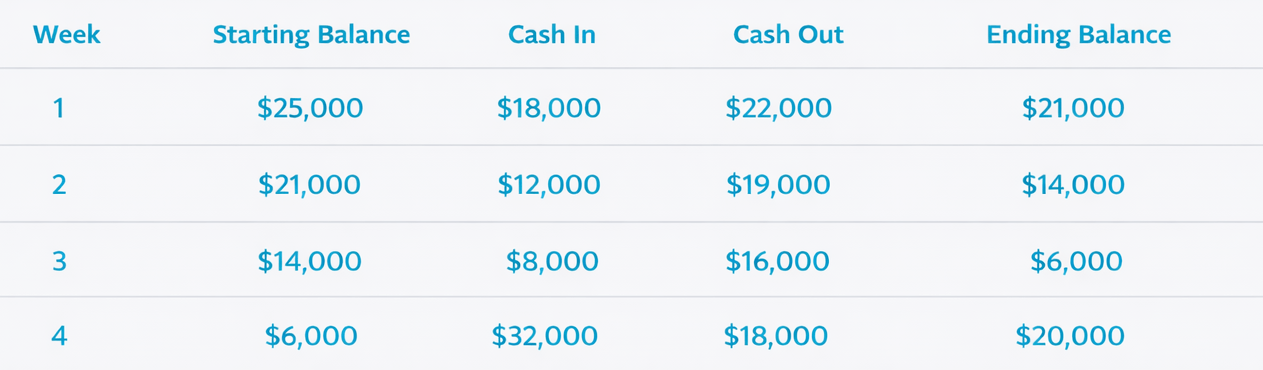
Week 3 is your constraint. You drop to $6,000. If something unexpected hits, you're in crisis.
Now you know. You can move a payment. Accelerate a collection. Delay a purchase.
You can't fix what you can't see.
3. Leading Indicators (What to Watch Before Crisis Hits)
Don't wait for your bank balance to scream at you. Watch these:
Days Sales Outstanding (DSO): How long it takes to collect payment after invoicing
Formula: (Accounts Receivable / Total Credit Sales) × Number of Days
Target: Under 45 days for most businesses
Rising DSO = cash flow crisis incoming
Cash Conversion Cycle: How long cash is tied up in operations
Formula: Days Inventory Outstanding + Days Sales Outstanding - Days Payables Outstanding
The shorter, the better
Negative = You collect before you pay (ideal)
Burn Rate: How fast you consume cash
Formula: (Starting Cash - Ending Cash) / Number of Months
Know your burn rate. Know your runway.
If burn rate > revenue growth rate, fix it now.
Cash Runway: How long you can operate at current burn rate
Formula: Current Cash / Monthly Burn Rate
Target: Minimum 3 months, preferably 6
Under 3 months = red alert
How to Fix Cash Flow Problems
(The O8 Constraint Method)
Cash flow is a constraint. You fix it the same way you fix any constraint: Identify. Exploit. Subordinate. Elevate.
Step 1: Identify Your Cash Flow Constraint
Which of the five killers is draining you?
The diagnostic:
Run a 13-week cash flow forecast
Identify when you hit your low point
Trace back to the cause
Is it:
Receivables taking too long to collect?
Inventory sitting too long before sale?
Fixed costs that jumped before revenue stabilized?
Tax timing you didn't plan for?
Owner draws based on feelings, not forecasts?
You can't fix all five at once. Find the constraint—the one that's bleeding you the most.
Step 2: Exploit the Constraint
Before you fix it permanently, maximize what you have.
If the constraint is receivables:
Call every overdue invoice this week
Offer early payment discounts (2% off for payment in 10 days)
Move largest outstanding invoices to the top of the collection list
Batch all collection calls to one afternoon per week
If the constraint is inventory:
Run a flash sale on slow-moving stock
Delay next inventory purchase by 2 weeks
Negotiate extended terms with your supplier (you pay in 30, not 15)
Stop buying "just in case" inventory
If the constraint is overhead:
Freeze all non-critical hires
Renegotiate contracts (software, space, services)
Cut any subscriptions you're not actively using
Defer discretionary spending for 60 days
If the constraint is tax timing:
Set up a separate tax savings account today
Transfer 30% of every deposit into it (automate this)
Don't touch it until tax time
If the constraint is owner draws:
Set a fixed monthly draw based on your forecast, not your feelings
Take draws twice a month at fixed intervals
Stop looking at account balance as "available to me"
Exploitation buys you time. Use it to elevate the constraint.
Step 3: Subordinate Everything Else
Don't optimize what isn't the constraint.
If receivables are killing you, don't spend time optimizing your inventory management. Don't reorganize your team. Don't launch a new marketing campaign.
Focus all energy on fixing the cash flow constraint. Everything else can wait.
Subordination means: Every other part of your business supports fixing the bottleneck.
Sales team focuses on collecting overdue invoices, not just new deals
Operations delays non-urgent purchases until after you stabilize cash
Marketing waits on new campaigns until you have runway
Step 4: Elevate the Constraint (Fix It Permanently)
Now you fix it so it doesn't break again.
If the constraint is receivables:
Change payment terms (net-15 instead of net-45)
Require deposits on large projects (50% upfront, 50% on delivery)
Automate invoice reminders (3 days before due, day of due, 3 days after)
Fire clients who consistently pay late (yes, really)
Offer incentives for faster payment (discount, priority service)
If the constraint is inventory:
Move to just-in-time ordering
Negotiate better supplier terms (pay in 30, not 15)
Track inventory turnover rate and adjust buying patterns
Drop products with slow turnover
If the constraint is overhead:
Tie hiring to revenue thresholds (no new hires until revenue hits $X)
Move to variable costs where possible (contractors vs. employees)
Renegotiate fixed contracts annually
Build a decision matrix for new expenses (revenue impact required before approval)
If the constraint is tax timing:
Automate tax savings (30% of every deposit goes to separate account)
Work with accountant to estimate quarterly taxes accurately
Build tax liability into your cash flow forecast
Never touch tax savings account except for taxes
If the constraint is owner draws:
Set fixed monthly owner compensation (treat yourself like an employee)
Take distributions quarterly based on actual profit, not monthly based on feelings
Separate business cash from personal cash (different accounts)
Don't draw until you've reviewed your 13-week forecast
You've now elevated the constraint. It won't break the same way again.
Step 5: Find the Next Constraint
Once you fix one cash flow constraint, another appears. That's not failure. That's how constraints work.
Fix receivables, and suddenly inventory timing becomes the bottleneck. Fix inventory, and overhead becomes the issue.
The hierarchy usually follows this order:
Receivables (most common first constraint)
Inventory/capital lock-up
Overhead timing
Tax planning
Owner draw discipline
You don't need to fix them all at once. You need to fix them in order.
The Operating System Component: How You Handle Financial Stress

Here's the part most cash flow advice ignores: Some owners can't follow a forecast even when they have one.
Not because they're irresponsible. Because their operating system isn't designed for delayed gratification.
Your financial operating system includes:
How you handle scarcity (panic vs. strategic)
How you make decisions under pressure (reactive vs. calculated)
How you process risk (conservative vs. aggressive)
How you relate to money (security vs. tool)
If your operating system says "I need to feel secure before I act" but cash flow requires you to delay payments strategically, you're fighting yourself. You'll pay everything immediately even when it's not optimal.
If your operating system says "I trust my gut" but cash flow requires data-based decisions, you'll keep drawing based on feelings instead of forecasts.
This is where The O8 framework matters: Fix both or fix neither.
You can build perfect cash flow systems. If your operating system sabotages them, they won't work.
Examples of operating system conflicts:
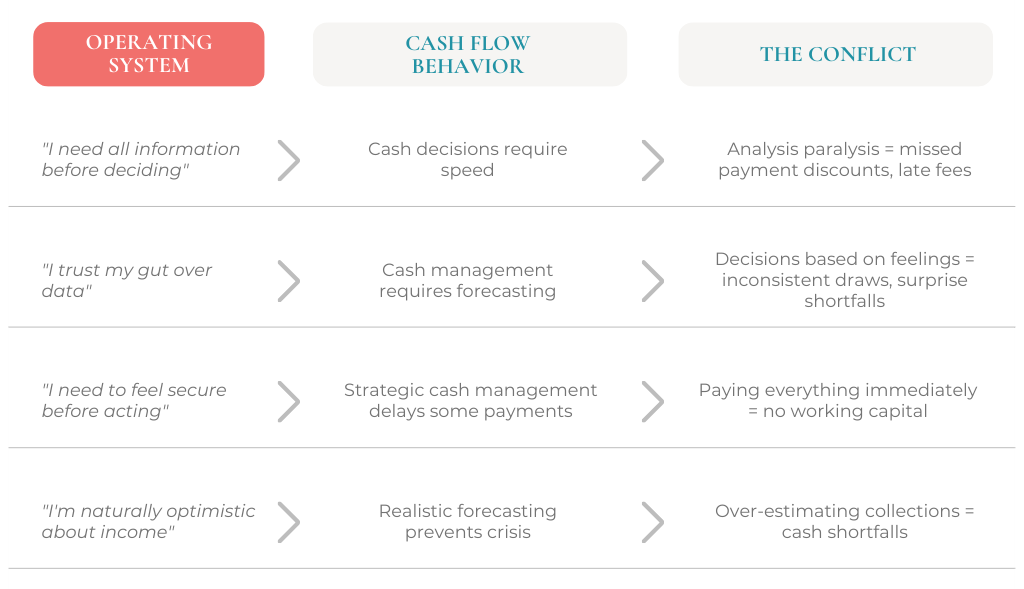
The O8 approach: Build cash flow systems that work with your operating system, not against it.
If you need security, build bigger cash reserves. If you're gut-driven, create simple decision triggers based on account thresholds. If you need all the data, build dashboards that give it to you fast.
Don't fight how you're wired. Design operations that work with it.
When Cash Flow Is Actually a Revenue Problem

Sometimes cash flow problems aren't timing problems. They're math problems.
The breakeven test:
Your business has a breakeven point—the revenue level where income exactly covers expenses. Below it, you're losing money. Above it, you're profitable.
If your cash flow problems persist even after fixing timing, you're probably below breakeven.
How to know:
Take your fixed monthly costs (rent, payroll, software, insurance—everything that doesn't change with sales).
Divide by your gross margin percentage (revenue - direct costs / revenue).
That's your breakeven revenue.
Example:
Fixed costs: $35,000/month
Gross margin: 60%
Breakeven revenue: $35,000 / 0.60 = $58,333/month
If you're consistently bringing in $50,000/month, you're not having a cash flow problem. You're having a revenue problem.
The fix isn't cash management. The fix is pricing, sales, or cost structure.
Don't confuse the two. Timing problems and math problems require different solutions.
The Cash Flow Forecasting System That Actually Works
Here's the implementation. Week by week.
Week 1: Build Your Baseline
Pull last 3 months of bank statements
Categorize every transaction (collections, payroll, rent, vendors, taxes, owner draws)
Identify patterns (when money comes in, when it goes out)
Note any irregular expenses (annual subscriptions, quarterly taxes)
Week 2: Create Your 13-Week Forecast
List every invoice you expect to collect (with realistic collection dates, not invoice dates)
List every expense you know is coming (payroll, rent, subscriptions, vendor payments)
Include irregular expenses (taxes, insurance, annual renewals)
Calculate weekly cash balance projections
Week 3: Identify Your Constraint
Find your lowest projected cash balance week
Trace it back to the cause (receivables? overhead? owner draw?)
Name the constraint specifically
Week 4: Exploit and Elevate
Take immediate action to exploit (accelerate collections, delay non-critical payments)
Build the permanent fix (change terms, automate savings, adjust draw schedule)
Update your forecast with new assumptions
Week 5-13: Monitor and Adjust
Update your forecast every Monday morning (15 minutes)
Compare actual to projected (learn from variance)
Adjust actions based on what's actually happening
When you fix one constraint, identify the next
This becomes your operating rhythm. Monday morning, 15 minutes, update the forecast.
You can't manage what you don't measure. Now you're measuring.
Common Cash Flow Mistakes (And How to Avoid Them)

Mistake 1: Managing to account balance instead of forecast
Your account shows $30,000. Looks good. Doesn't mean you have $30,000 to spend. You have committed expenses coming.
Fix: Only make spending decisions after checking your 13-week forecast.
Mistake 2: Confusing profit with cash
Your P&L says you made money. Your bank account says otherwise. Profit is accrual. Cash is reality.
Fix: Track cash flow, not just profit.
Mistake 3: Not separating tax savings
You made $100,000 profit. You spent $100,000. Tax bill arrives. You owe $30,000. You don't have it.
Fix: Automate tax savings. 30% of every deposit into separate account. Don't touch it.
Mistake 4: Agreeing to payment terms without modeling impact
Client wants net-60. You say yes. You just gave them a $50,000 interest-free loan without realizing it.
Fix: Model payment terms before agreeing. Know the cash impact.
Mistake 5: Taking owner draws based on feelings, not forecasts
Account balance looks healthy. You take $20,000. Next week, payroll hits. You're short.
Fix: Fixed monthly draw based on forecast. Quarterly profit distributions if forecast supports it.
The Reality Check
Cash flow problems aren't about being bad with money. They're about timing gaps you didn't design for.
You can be profitable and broke. Both are true simultaneously.
The fix isn't hoping it gets better. The fix is identifying the constraint—where the timing breaks—and elevating it permanently.
The O8 framework: Operations + Operating System.
Build the systems. Understand how you're wired to handle financial pressure. Design one to work with the other.
Fix both or fix neither.
Your cash flow constraint is killing you right now. You don't need more revenue. You need better timing.
Build the forecast. Find the constraint. Fix it.
Or stay broke despite being profitable. That's a choice too.
Related Reading:
How to remove yourself from daily business operations (operational constraints)
The 6 bottlenecks every business hits (constraint hierarchy)
How to delegate as a business owner (decision-making constraints)
THE GETAWAY
Your final destination for ditching the overwhelm and stress of running a business.
Get The BRIEF
Smart plays - straight to your Inbox!
Stay Connected
Hey there, let's hang out!