The MONEY PLAY is HERE - Money done for you.
Become an O8 Affiliate – Earn 20% commission on all sales.
Stop Checking If They Did It. Start Checking If The System Works.
You built the system. Filled the gaps. Handed it back.
And you're still checking their work every single time.
Not because the system isn't working. Because you haven't changed what you're checking for.
And because letting go feels impossible.
Why Letting Go Is Hard

Here's what nobody tells you about systemizing: the mechanics are easy. The psychology is brutal.
Sally Atkinson, professor at Cranfield School of Management, studies trust in business relationships. Her finding? "In the context of a business relationship, trust is all about risk. The more a manager's reputation or personal fortune depends on someone else's performance, the more there is to lose—and the less likely it is that trust will be conferred."
Your business isn't just your income. It's your identity. Your reputation. Your family's security.
Handing that to someone who clocks out at 5pm? That's not a delegation problem. That's a psychological problem.
Research on psychological ownership shows that business owners suffer from what psychologists call "territoriality"—an inability to delegate responsibility because everything feels like yours to protect.
You're not being controlling. You're being human.
But here's the trap: the tighter you hold on, the more you have to do yourself. And the more you do yourself, the less your business can grow.
You're Still Checking the Wrong Thing
You're checking if Sarah sent the quote correctly.
You should be checking if the quote system works.
You're checking if Mark followed up on the estimate.
You should be checking if the follow-up system works.
One keeps you in the weeds forever. The other makes you the architect.
Michael Gerber said it plainly: "The system runs the business. The people run the system."
You're still trying to run the people. That's why you're still checking.
What Checking the System Actually Looks Like
Person-checking: "Did Sarah remember to add travel time to the quote?"
System-checking: "Does the quote template make it impossible to skip travel time?"
Person-checking: "Did Mark follow up on that $3,000 estimate?"
System-checking: "Does the CRM automatically remind Mark to follow up after 3 days?"
Person-checking: "Did the invoice go out on time?"
System-checking: "Does the system flag any job that's complete but not invoiced?"
The difference? You're testing the system, not policing the person.
When you check if they did it, you're quality control.
When you check if the system works, you're designing the business.
Greg McKeown puts it this way in Essentialism: "Essentialists invest the time they have saved by eliminating the nonessentials into designing a system to make execution almost effortless."
Not checking constantly. Building once.
How to Tell If It's a System Problem or a People Problem
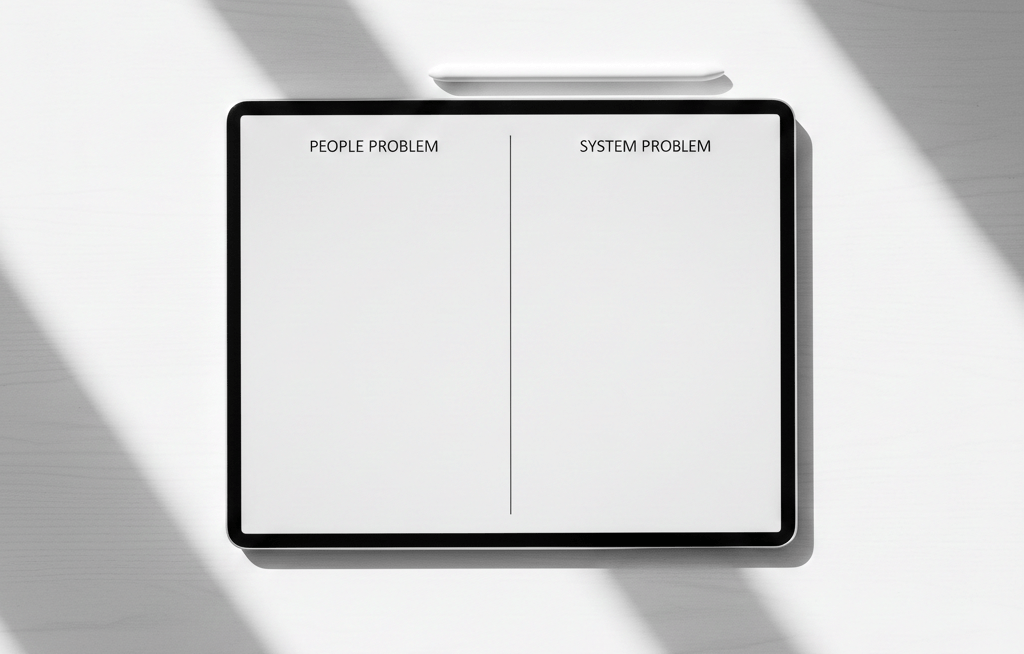
If one person gets it wrong consistently: People problem. They're not following the system or they need training.
If everyone gets it wrong: System problem. The system isn't clear enough.
If it gets wrong when they're busy: System problem. Too many decisions required. Simplify it.
If it gets wrong inconsistently: System problem. What "right" looks like isn't obvious enough.
If you're tempted to check it every time: System problem. The system doesn't give you confidence.
Sarah's Breaking Point

Sarah's quoting system worked for two weeks.
Then she caught herself checking quotes again. Every single one. Before they went out.
Her admin asked why. Sarah said: "You keep forgetting travel time."
Her admin looked confused. "I put it in when there's travel."
"But you're forgetting it sometimes."
"I don't know when there's supposed to be travel."
Sarah felt it hit her: this wasn't about her admin not paying attention. The system had a gap.
The quote template had a field for travel time. But it wasn't required. It could be left blank. And her admin genuinely didn't know when to use it.
Sarah went home that night and added one line to the system: "Quote cannot be sent until travel time field is completed. Enter 0 if no travel applies."
The next morning, her admin sent three quotes. Travel time was on all of them.
Sarah didn't check them.
Two weeks later, Sarah realized she hadn't looked at a quote in days. Not because she trusted her admin more. Because she didn't need to. The system wouldn't let it go out wrong.
She told me later: "I thought I was being a good boss by checking everything. I was actually being a bad architect."
Mark's Surrender

Mark's follow-up system worked for a month. Then estimates started slipping through again.
Mark was furious. "I gave him the system. He's just not using it."
I asked: "What happens when he dismisses the reminder?"
Mark paused. "What do you mean?"
"The CRM sends a reminder after 3 days. What happens if he just closes it?"
"It... disappears."
"So the system lets him dismiss it without doing anything?"
Mark stared at me. "The system lets him ignore it."
Not a people problem. A system problem.
Mark adjusted it that afternoon: "Estimate reminder cannot be dismissed until follow-up is logged or estimate is marked declined."
His service manager stopped "forgetting." Not because Mark reminded him more. Because the system wouldn't let him move forward without doing it.
Mark told me three weeks later: "I spent two years thinking he was the problem. Turns out I built a system that let him fail."
Build Systems That Catch Their Own Errors
You're not the quality control. The system should be.
Automated checks:
Can't send a quote without selecting a service tier
Can't close a job without completing the checklist
Can't mark invoice sent without attaching the PDF
Visual flags:
Invoice turns red if unpaid after 14 days
Jobs without follow-up dates show in orange
Quotes sitting longer than 5 days trigger an alert
Hard stops:
System won't advance to next step until current step is complete
Required fields can't be skipped
Decisions that matter can't be left blank
The system catches mistakes before they become problems.
You don't need to watch. The system does.
David Jenyns talks about this in SYSTEMology: "The secret to ensuring your business develops a culture where systems are not just created, but actually used, is to introduce some level of accountability."
But accountability doesn't mean you checking everything. It means the system makes it obvious when something's wrong.
When to Fix the System vs When to Trust It

Three errors in three days? Fix the system. Something's unclear or missing.
One error in three months? Trust the system. Anomalies happen. Don't redesign for edge cases.
You're tempted to check every single time? The system needs work. You don't trust it yet. That's a system problem, not a you problem.
You forget to check for weeks and nothing breaks? The system works. Leave it alone.
What Changes
Sarah hasn't checked a quote in two months.
Not because she cares less about quality. Because the system won't let quotes go out wrong.
She told me last week: "I used to check quotes at 9pm while my kids did homework. Now I don't even think about quotes. They just... happen."
That's the shift. From doing to designing. From checking to trusting.
Mark hasn't chased a follow-up in six weeks.
He said: "I thought delegation meant trusting people more. Turns out it means building systems that don't require trust."
Neither of them stopped caring. They stopped being the mechanism.
GoodThe relief in their voices when they talk about it? That's real.
Years of holding everything together. Finally able to let go.
Not because they hired better people. Because they built better systems.
The Shift
You can't trust people you have to watch constantly.
But you can trust systems that don't need watching.
Stop checking if they did it right.
Start checking if the system makes "right" the only option.
That's not micromanaging. That's architecture.
And that's how you finally get your evenings back.
THE GETAWAY
Your final destination for ditching the overwhelm and stress of running a business.
Get The BRIEF
Smart plays - straight to your Inbox!
Stay Connected
Hey there, let's hang out!